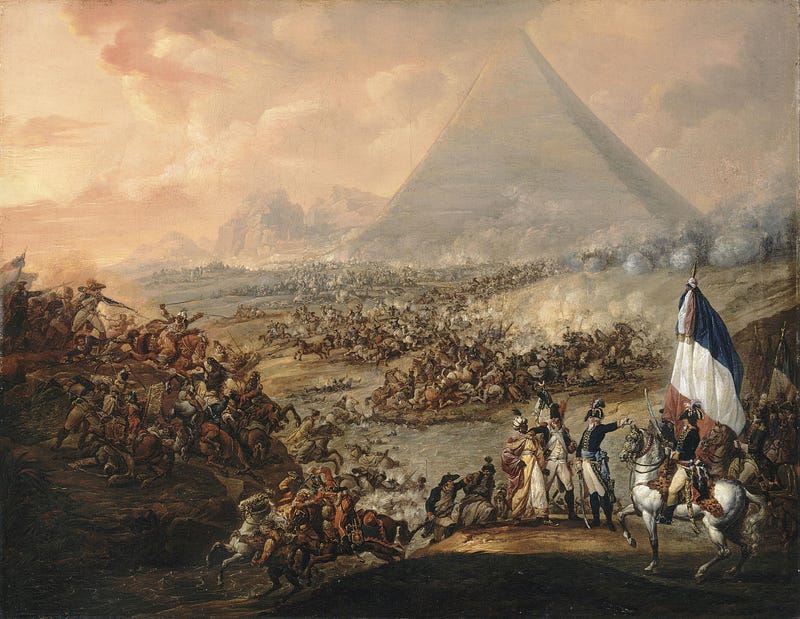
I was re-reading Le Fil de l’Épée on a flight last month — de Gaulle’s early treatise on leadership, which I return to every few years like some people return to certain albums. There is a passage where he describes France in the interwar period: its generals dutifully holding committees on how to optimize infantry charges, writing reports on autonomy and initiative and bottom-up doctrine, while the other side was building tanks. The committees were not staffed by idiots. The reports were serious and well-argued. The doctrine was internally consistent. It was simply designed for the wrong world.
I put the book down somewhere over the Alps and sat with that for a while.
Because what de Gaulle was describing in 1932 is what I watch happen in board meetings today. The setting is different — open-plan offices, slide decks, transformation roadmaps with color-coded RAG statuses — but the structure is the same. Intelligent, well-intentioned people organizing their thinking around a world that has already moved on.
I run OSS Ventures, a venture studio that builds AI-native B2B software companies for operations. We’re five years old, our 24 companies have collectively over 200 000 users and live in 3 800 operational sites. Over the last 18 months, I have sat in more board meetings and founder sessions than I can count, across roughly 20 portfolio companies and dozens of enterprise relationships. The same question keeps surfacing, in different rooms, in different languages, with different levels of anxiety attached to it: what do we do when everything is changing this fast?
I don’t have a framework nor consultants to sell. I have field notes. And some pattern that have become impossible to ignore.
The Question That Haunts Every Boardroom
The question comes in two flavors. The first is strategic: how do you position a business when the technology landscape is moving faster than your planning cycles? The second is human: how do you manage a team through a shift that none of you fully understand yet?
Both are legitimate. Both deserve honest treatment.
But after enough of these conversations, I’ve noticed something. The quality of the question tells you almost everything about the quality of the leadership. Strong leaders ask both with genuine curiosity, as if they are actually trying to figure something out. Weak leaders ask them in a way that is subtly performative — the question is doing social work, signaling engagement, buying time.
I know that sorting people into “strong” and “weak” is a blunt instrument. People are complicated. But after you sit across the table from enough of them in hard moments, patterns emerge. There is a consistent behavioral profile that correlates with getting through this period, and a consistent one that correlates with not. I’ll try to describe both without being cruel about it.
The Leaders Who Are Making It: They Did It Themselves
The single clearest signal I have found — clearer than strategy, clearer than funding, clearer than team quality — is whether the leader personally did the work of learning.
The ones who are making it did not delegate this. They sat down with the tools themselves. They tested, broke things, rebuilt them, asked junior employees embarrassing questions without embarrassment. They wrote code. They built automations. They used the products their companies were building, for real, not in demo mode. And then they showed up to board meetings and internal meetings alike with opinions that came from experience rather than from briefings.
This matters more than it looks like it should. When a leader has done the work personally, something shifts in how they operate. They can tell the difference between an engineer who has hit a real wall and one who is quietly resisting change. They can form their own view on product direction rather than triangulating between whatever the last consultant said and whatever their VP of Product believes this week. They have calibrated instincts because they have calibrated themselves.
The leaders who are struggling share a particular characteristic: they are trying to lead a transformation they have not personally gone through. They attended some conference. They read the reports. They commissioned the strategy decks. They can speak fluently about AI in a general way. But they have not had the specific experience of sitting alone with the tools, feeling clumsy and slow, and doing it anyway. That experience — the private, slightly humbling experience of actually learning — is what makes the difference. Without it, they are leading from a map of a country they have never visited.
One founder I work with — one of the ones fully through the transition now — told me early on that he had made a rule for himself: before asking his team to do anything AI-related, he would do a version of it himself first. He meant it literally. He would spend the weekend before a sprint building the thing he was about to ask his engineers to build, badly, just to understand what he was asking. He showed up Monday mornings with bruised confidence and very specific questions. His team noticed. It changed how they worked.
The False Kaizen Argument
I want to describe one failure mode specifically, because I have watched it cause serious damage and it tends to hide behind respectable language.
Several leaders, when pressed on what their transformation looked like, pointed to Lean and Kaizen. “We trust our teams to figure this out from the ground up.” “Our culture of continuous improvement will do the work.” “We don’t want to impose top-down.” It sounded thoughtful. It was, in practice, a way of not deciding.
Kaizen is a powerful tool. It is the right tool when you know where you are going and want to eliminate waste along the path. It assumes a stable direction and optimizes execution toward it. What it cannot do is generate a new direction. When the destination itself is in question — when the entire business model is under pressure, when the product needs to be rethought from the ground up — continuous improvement of the existing path is not a strategy. It is a delay.
The right instrument in that situation is Hoshin. Hoshin Kanri is about top-down strategic alignment: the leader makes a call about where the organization is going, communicates it clearly, and holds people accountable to it. It requires taking a position. It requires being wrong in public if the position turns out to be wrong. It requires, in short, the things that are hardest to do.
What I came to believe — after watching this pattern repeat — is that the leaders who invoked Kaizen were doing so not because they thought it was the right tool, but because they did not want to be the ones responsible for calling the direction. Kaizen distributes ownership downward. If the team figures it out, the team owns it. If the team fails, the leader was simply empowering people. It is a way of being in charge without accepting the weight of being in charge.
That is a tempting position. It is also the wrong one, and organizations feel it immediately.
On Vision: You Cannot Outsource Belief
There is a related tell I have seen almost as often. The leader who, when pressed on strategic direction, has commissioned a consultancy to write the company vision. It arrives in a deck — 40 slides, expensively formatted, always three months late, always built around a 2x2 matrix that puts the company in the top-right quadrant. The leader presents it to the board as their strategic direction. Sometimes they present it to the whole company at an all-hands, reading from slides they are encountering almost as freshly as the audience is.
The implicit argument is that vision is a deliverable. Something that can be procured, refined in workshops, and installed like a software update. It cannot.
Vision is what the leader personally believe about where the world is going and why your organization is specifically positioned to meet it there. It comes from reading, client conversations, restless thinking on planes and early mornings. It is, at its core, a bet — and you have to be the one making it, because you are the one who will have to defend it when the data gets messy, when the board gets nervous, when a competitor does something unexpected and everyone in the room turns to look at you.
If you did not form it yourself, your people will feel that. Not in the town hall where it is announced, but in every decision you make afterward. Every time the strategy is tested under pressure. Every moment when someone in the team needs to know whether the person at the top is actually convinced, or whether they are reading from someone else’s map.
On Business Strategy: Vision Versus Complaint
The strategic split between strong and weak leaders is just as stark, and just as human.
Strong leaders look at a period of technological disruption and ask: where is this going, and how do I get there first? They build a point of view on what their clients will need before their clients can fully articulate it. They go and test the idea commercially, early, imperfectly, adjusting as real data comes back. They treat uncertainty as part of the conditions, not as a reason to wait for clarity that will probably never arrive.
There is a sentence I have heard from weak leaders, in different phrasings, more times than I would like: “Our clients haven’t asked for AI specifically.” Sometimes it comes with a shrug. Sometimes with a faint suggestion that this proves the whole thing is overhyped. The argument being made is: we are customer-centric, and our customers have not demanded this, therefore we are not going to move until they do.
I understand the instinct. It feels responsible. It feels like discipline. But it is a misreading of what customer-centricity actually means.
Clients tell you about their problems. They rarely tell you about the solution — and when they do, they are usually wrong about the details. The job of a leader is to listen to the problems, form a view on the solution, and build toward it before someone else does. Every product that changed a market was built ahead of explicit customer demand. Waiting for clients to specify the answer is not respect for the customer. It is a way of outsourcing a decision you should be making yourself.
The leaders who are ahead right now are the ones who formed a view, went and tested with clients at the economic level — not “do you find this interesting?” but “would you pay for this, and how much?” — and kept refining based on what they found. That is the whole game.
On Managing People: Honesty Is the Kindness
The human dimension of this has surprised me the most, because the failure mode here is genuinely well-intentioned.
The instinct among the leaders who struggled was to protect their teams from the discomfort of the transition. Gentle messaging. Long change management plans. Gradual rollouts engineered to minimize friction. The implicit promise underneath all of it was: this will not disrupt your life too much; we are in control; trust us.
This made things worse, consistently. And I think I understand why. People are not naive. They can see the world changing even when the company communication is narrating something softer. When leadership and reality diverge, people do not choose to believe leadership — they choose to be anxious in private. The protection backfired: teams were unsettled, had no framework for what was actually happening, and filled the gap with rumor and worst-case assumptions.
The leaders who handled this well told their teams the truth, including the parts they did not know yet. I watched one CEO stand in front of 60 people and say, roughly: this technology is changing everything about what we do, faster than I have ever seen anything move. Some of your roles will change significantly. Some things I cannot predict yet. What I can promise you is that I will tell you what I know when I know it, and I will not manage you toward a comfortable fiction.
The room was quiet for a moment. Then people started asking real questions. It became the most productive all-hands that company had had in two years.
People can absorb uncertainty when it comes with honesty and a sense that someone is genuinely holding the problem. What they cannot absorb is the gap between what they are being told and what they can see with their own eyes.
Success Compounds, and So Does Failure
There is something uncomfortable in this data that I want to name directly, because I think it matters for anyone managing a portfolio or running an organization through this period. The AI transition is not a reset. It is not a leveler. It does not give struggling organizations a fresh start or a chance to leapfrog stronger competitors by adopting a new technology. What I have watched, consistently, is the opposite: the transition rewards organizations that were already strong, and punishes organizations that were already fragile.
The companies moving fastest through this are the ones that already had strong leadership, high-trust teams, and a culture where people were expected to think rather than execute instructions. Those organizations took the turn quickly because the underlying conditions for change were already there. The leadership had credibility. The teams were used to being challenged and responding. The culture could absorb uncertainty without fracturing. AI gave them another gear. They used it.
The companies struggling the most are the ones that were already carrying organizational debt — unclear leadership, teams that had learned to wait for direction rather than generate it, cultures built on process compliance rather than judgment. For those organizations, the AI transition did not reveal a path forward. It revealed everything that was already wrong. A weak leader who could not form a vision before is not going to form one now under more pressure with faster-moving technology. A team that was not trusted to act with autonomy before is not going to suddenly develop that capacity because the tools changed.
I do not say this to be fatalistic about the companies in the harder group. I say it because the honest diagnosis matters. If your organization is struggling with this transition, the root cause is probably not the technology. It is almost certainly something older, something human, something that needs to be addressed at the level of leadership and culture before the tooling conversation becomes productive. Trying to solve it by adopting AI faster is like trying to fix a weak foundation by adding more floors.
Interestingly (there is hope, believe it or not) the cultural setting of the company. I have seen (see below) companies ith very little cash reserve outperform wildly incredibly well funded competitors. I have seen small teams outperform large organizations. It seems what matters most is the organizational culture and health of the companies, more than anything else.
Internal Data From 15 Companies
At OSS we have 15 portfolio companies that were built before the current AI wave — traditional SaaS businesses, operating in industrial sectors, built on assumptions that the last two years have shaken considerably. We have watched all 15 navigate this from close range, with board seats and operating reviews and the kind of candor that comes from genuine partnership.
Our field estimate, as of now: 4 are fully AI-native. By that I mean most of their new revenue growth comes from AI-enabled products, and internally, people are using AI as a real part of their daily work — not as a feature they added to the website, not as a pilot running in one corner of the business. Actually native. 7 are on track, meaning they are moving in the right direction and will get there within two quarters if they maintain their current pace. 4 are not on track, and the trajectory suggests they will not get there soon.
The thing that determined which group a company ended up in was not market position. It was not how much money they had raised. It was not even the quality of the product, though the product eventually reflects everything else. It was the person at the top, and specifically: how fast they were willing to personally change.
The 4 that are not making it have leaders who delegated the learning, waited for the market to write the strategy for them, and communicated reassurance to their teams when honesty would have served better. The 4 that are fully through it did the opposite on every count.
But the ones that are making it are posting incredible results :
- A company is outperforming and out-selling competitors that had roughly 7 times the fundraising ;
- A company went from 30% to 290% growth YoY while shrinking the team ;
- A company had more C-level discussions in the last 3 months than in the previous 3 years combined.
Very Old-Fashioned Values
What strikes me most about all of this — what I keep returning to — is how little of it is new.
The qualities that separate the leaders who are getting through this from the ones who are not are not particularly sophisticated. They are not modern. They look almost old-fashioned alongside the vocabulary of contemporary management: psychological safety, agile transformation, continuous improvement cultures, servant leadership. None of that is wrong, exactly. But none of it is what is doing the work right now.
Leading from the front. Not as a stated value on a company website. Actually from the front — personally doing the hard thing first, understanding what they are asking of their people because they have already asked it of themselves.
Responsibility and urgency. A genuine personal sense of responsibility for outcomes, not ownership of the process but ownership of the result. Urgency that is real, not performed. Responsibility to lead teams in times of change.
Speed and decisiveness. Speed has a virtue in itself. If your organization is strong, it’ll weather a few inadequacies. Strong employees may even see this as a sign of strength.
Agency — the stubborn belief that what you do changes what happens, even in conditions of genuine uncertainty, matters. That the client, the board, another X post will not save an organization.
Courage to call a direction without full information. To also clearly state that the organization could lose in the upcoming era. That mistakes could be made. Courage to move quickly and not follow the fallacy of “the market will discover and then we’ll catch up”. Courage to maybe pass for a fool and ask the dumb questions to search for the truth.
Honesty. With oneself about the status of the bet being made. With boards on what is known and unknown, what works and what doesn’t. With the team about what is known, what is not known, and what that means for everyone.
None of these values are on any consultant’s trend list. They are the same things that have mattered in every hard period of organizational life, in every organization, across history. What this moment has done is strip away the conditions that allowed leaders to go without them. When change is slow and the environment is stable, process can compensate for gaps in character. Systems absorb the uncertainty and produce acceptable outcomes even when the person at the top is not especially courageous or direct. When change is this fast and this wide, the buffers disappear. What remains is the leader. Their judgment, their personal speed, their willingness to be wrong and correct fast, their ability to carry a team through uncertainty without lying to them.
No system substitutes for that. I have not seen one.
Back to the Generals
De Gaulle was not saying the French generals were stupid. He was saying they were optimizing for the previous war. They had studied it carefully, drawn real lessons from it, and crystallized those lessons into doctrine they applied with great discipline. The rigor was genuine. The problem was the map.
That is the risk I see in front of the leaders I work with — the ones who are not making it. Not stupidity. Comfort. Committees feel productive. Transformation roadmaps feel responsible. Kaizen feels humble and team-centered. Bringing in an outside consultancy to run a 90-day diagnostic feels like due diligence. And every one of these things is, at some level, a way of organizing intelligent effort around the act of not deciding.
The leaders who are making it through this period are not always the smartest people in the room. They are not the ones with the most resources or the most sophisticated operations. They are the ones who were willing to stand up and say: here is where we are going, here is why I believe it, and we start now. And then they went first.
That is a very old idea. Right now, it might be the only one that matters.
Let’s build.