Philosophy
Maps, notes, and explorations in philosophy.
56 entries
- Barbara Stiegler — the imperative to adapt, and democracy against it
The Bordeaux philosopher who traced “you have to adapt” back to Walter Lippmann's biological reading of politics and set John Dewey's experimental democracy against it — from Nietzsche and biology to the syndemic critique of pandemic governance. Her life, main ideas, critiques, and impact.
- Mark Fisher — capitalist realism, hauntology, and lost futures
The k-punk blogger and Goldsmiths lecturer who named the feeling that there is no alternative: capitalist realism, reflexive impotence, the privatization of stress, hauntology and the slow cancellation of the future, the weird and the eerie. His life, main ideas, critiques, and impact.
- Muphry's Law — a reader's summary
The deliberate misspelling of Murphy's Law that John Bangsund set down in a 1992 Australian editors' newsletter, its older echoes in Ambrose Bierce and a 1989 Paul Dickson anecdote, and how a 2003 Usenet corollary called Skitt's Law turned it into the reflex every online correction now triggers.
- Occam's Razor — a reader's summary
The parsimony principle credited to a 14th-century friar who never wrote its famous Latin tag, the 1918 Mind article that traced the myth of that wording, the 19th-century coinage of the name itself, and why 'the simplest explanation' gets misquoted in almost every online debate that reaches for it.
- Epistemic Learned Helplessness — a reader's summary
Scott Alexander's 2013 term for giving up on adjudicating persuasive arguments, its debt to Martin Seligman's 1967 dogs, and why an internet built on confident, rapid argument keeps recreating the exact conditions the term describes.
- No True Scotsman — a reader's summary
Antony Flew's mid-1970s invented anecdote of Hamish and Angus, the redefinition move that rescues a sweeping claim from a counterexample, and why “real communism has never been tried” is the phrase every informal-logic reference reaches for first.
- The Spotlight Effect — a reader's summary
Thomas Gilovich, Victoria Medvec and Kenneth Savitsky's 2000 Cornell study of an embarrassing T-shirt worn into a room of strangers, the 1998 “illusion of transparency” it grew out of, and why the same overestimate of an audience now shows up every time someone hesitates before hitting post.
- Charles Péguy — mystique, hope, and the incarnation of the eternal
The socialist Dreyfusard who returned to Catholicism, the poet of hope and of Joan of Arc, the fiercely independent editor of the Cahiers de la Quinzaine — killed on the eve of the Marne. His life, main ideas, critiques, and impact.
- AI Psychosis — a reader's summary
The media term for delusions reinforced by chatbot conversation — the May 2025 Rolling Stone report, a UCSF psychiatrist's dozen hospitalizations, two wrongful-death lawsuits, and why clinicians say the name outruns the diagnosis.
- The Bible — corpus and transmission
How the Old and New Testament canons were formed, and how the text travelled from the Masoretic Hebrew and the Greek Septuagint through the Vulgate to the vernacular translations and critical editions of today.
- The Bible — its books and their sections
Every book, from Genesis to Revelation — Old and New Testaments plus the deuterocanon — each opening to its internal sections (the cycles, discourses, and movements beneath the book), with their main messages.
- The Qur'an — corpus and transmission
What the Qur'an is, how it moved from recitation to a single written codex under Uthman, and how the canonical readings, the diacritical script and the 1924 Cairo edition stabilized its text — with the manuscript evidence.
- The Qur'an — its 114 surahs
Every chapter, from Al-Fatiha to An-Nas, with its main message — searchable and filterable by Meccan or Medinan revelation.
- The Torah — corpus and transmission
The Five Books of Moses: how tradition and modern scholarship account for their making, and how the scribes and Masoretes transmitted the text with famous exactness.
- The Torah — its 54 portions
The weekly Torah portions (parashot) read through the Jewish year, from Bereshit to V'Zot HaBerachah, each with its main message — filterable by the five books.
- The Bandwagon Effect — a reader's summary
Harvey Leibenstein's 1950 demand-theory paper that named it, Herbert Simon's 1954 model of poll-driven voting, the 1992 cascade theory that complicates the “sheep” reading of it, and why a trending tab is the same effect wearing a UI.
- Cognitive Dissonance — a reader's summary
Leon Festinger's 1957 theory, the doomsday-cult study that gave it its most famous test, the $1/$20 experiment that made it a textbook staple, and how the term became loose internet shorthand for any inconsistency at all.
- Encyclicals & their ideas
Every encyclical, tagged by thesis, subjects and main ideas — one clickable card each, opening to its key ideas, searchable and filterable by doctrinal family.
- Gaël Giraud — energy, the common good, and the financial illusion
The mathematician, economist and Jesuit priest who puts energy and the common good back into economics: the hidden energy engine of growth, the financial illusion, money as a common good, and the great ecological transition — a guide to his work.
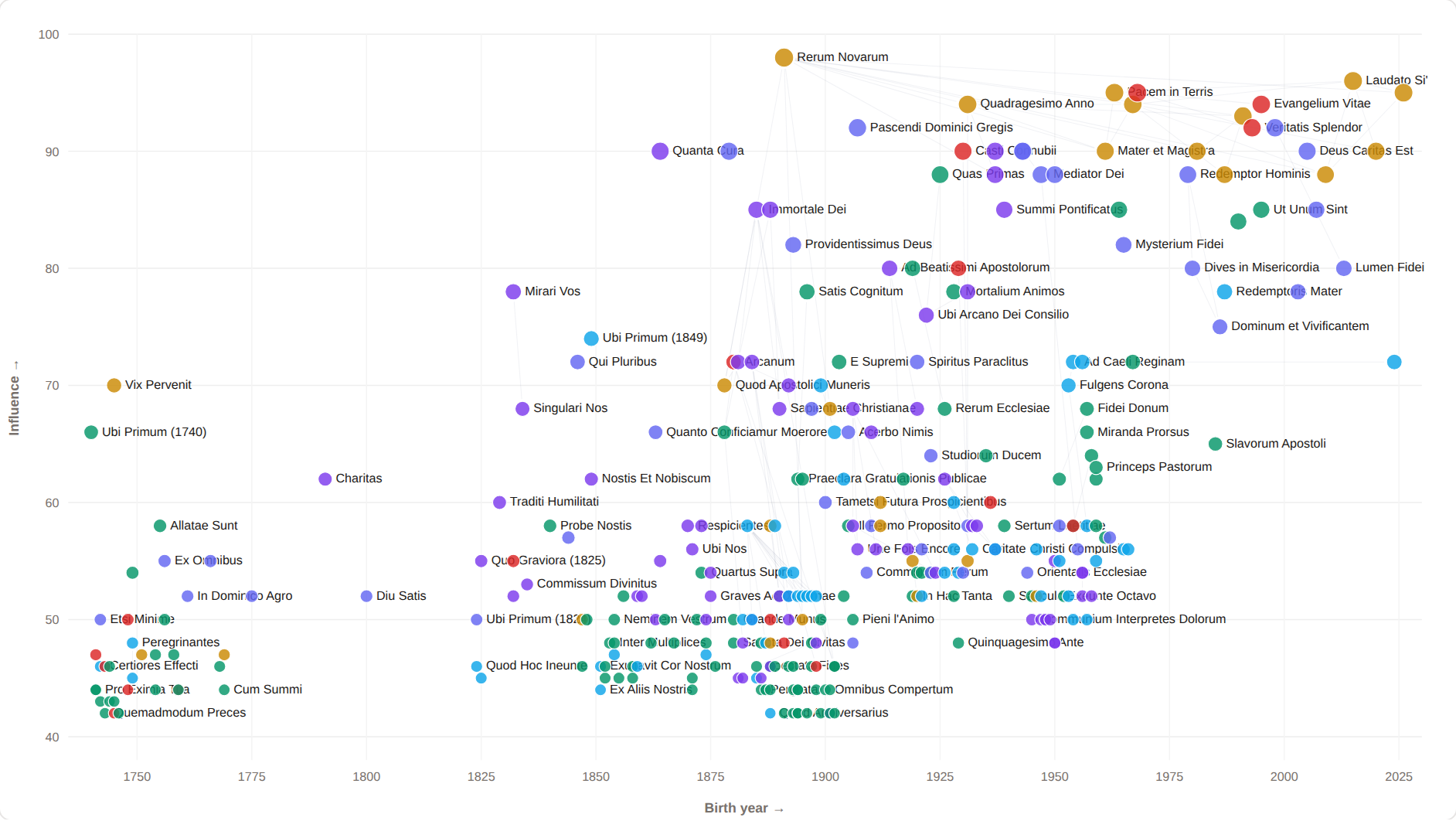
- The encyclical map
Every papal encyclical from Benedict XIV (1740) to Leo XIV, placed by year and doctrinal weight and linked by lines of influence — the shape of modern Catholic teaching on two axes.
- Survivorship Bias — a reader's summary
Abraham Wald's 1943 aircraft-armor memo, the mutual-fund papers that turned it into a measured, dollar-figure effect, and why the viral bullet-hole diagram everyone has seen is a later illustration, not the original document.
- The Mere-Exposure Effect — a reader's summary
Robert Zajonc's 1968 finding that repeated exposure alone increases liking, Edward Titchener's 1910 “glow of warmth” that anticipated it, and why a feed built to repeat things is also a machine for making you like them.
- Negativity Bias — a reader's summary
The two independent 2001 papers that named why bad outweighs good, the evolutionary logic behind it, and the 2023 randomized headline experiment that measured its price in clicks.
- Confirmation Bias — a reader's summary
Peter Wason's 1960 rule-discovery experiments, Francis Bacon's 1620 anticipation of the same pattern, and why an engagement-optimized feed rewards exactly what the bias looks for.
- The Zeigarnik Effect — a reader's summary
Bluma Zeigarnik's 1927 Berlin experiment finding unfinished tasks recalled roughly twice as well as finished ones, the waiter's-memory anecdote that inspired it, and why progress bars and cliffhangers still lean on it.
- Weaponized Incompetence — a reader's summary
A 2007 Wall Street Journal column on “strategic incompetence,” the summer 2021 TikTok wave that renamed it for household chores, and the therapist pushback that the label now travels faster than the diagnosis.
- Love Bombing — a reader's summary
A 1970s Unification Church recruitment tactic named in a 1978 Sun Myung Moon speech, Margaret Singer's 1996 book that carried it into psychology, and the 2017 study that reframed it as a narcissistic courtship pattern.
- The Halo Effect — a reader's summary
Edward Thorndike's 1920 army-officer ratings, the 1977 experiment that caught the effect working below conscious awareness, and why a verified badge or a clean thumbnail still gets read as proof of everything else about a person.
- The Sunk Cost Fallacy — a reader's summary
Hal Arkes and Catherine Blumer's 1985 theater-ticket experiments, the Concorde fallacy nickname, and why “I've already put so much in” keeps winning arguments about when to quit.
- The Baader-Meinhof Phenomenon — a reader's summary
The 1994 forum coinage for suddenly noticing something everywhere, Arnold Zwicky's 2005 “frequency illusion” rename, and why the name has nothing to do with what it describes.
- The Uncanny Valley — a reader's summary
Masahiro Mori's 1970 hypothesis that near-perfect human likeness triggers revulsion, its 35-year wait for an English translation, and why AI video and voice reopened it.
- The Mandela Effect — a reader's summary
Fiona Broome's 2009 name for a shared false memory, the Berenstain Bears and Monopoly Man variants it produced, and why cognitive science already explained it before the multiverse theory did.
- The Barnum Effect — a reader's summary
Bertram Forer's 1948 classroom experiment that gave every student the same “personalized” sketch lifted from an astrology column, Paul Meehl's 1956 name for it, and why horoscopes, quizzes, and flattering AI chat lean on the same gap.
- Roko's Basilisk — a reader's summary
The 2010 LessWrong thought experiment about a future AI that punishes those who knew of it and didn't help build it, Eliezer Yudkowsky's ban that turned it into a meme, and the decision-theory rebuttal that undercuts it.
- Sturgeon's Law — a reader's summary
Theodore Sturgeon's 1950s retort that “ninety percent of everything is crap,” born as a defense of science fiction, and how it became the default shorthand for grading online content in bulk.
- The Backfire Effect — a reader's summary
Nyhan and Reifler's 2010 finding that correcting a false belief can sometimes deepen it, David McRaney's blog that turned it into a household term, and the 2019 replication that found genuine backfire is the exception, not the rule.
- Illusory Truth Effect — a reader's summary
Hasher, Goldstein and Toppino's 1977 finding that repetition alone makes a claim feel truer, Lisa Fazio's 2015 result that knowing better doesn't fully protect you, and why the feed is a near-ideal delivery mechanism for it.
- Hanlon's Razor — a reader's summary
“Never attribute to malice what is adequately explained by stupidity” — a 1980 joke-book submission, its older echoes in Robert Heinlein, and why it now moderates online arguments about intent.
- Chesterton's Fence — a reader's summary
G.K. Chesterton's 1929 parable of a fence across a road, and how a century-old essay became a standing rebuttal in online arguments about removing things nobody remembers building.
- Gaslighting — a reader's summary
The 1938 stage thriller the term is named after, its 1960s-70s move into clinical vocabulary, and Merriam-Webster's 2022 word-of-the-year recognition of how far it has spread.
- Motte-and-Bailey — a reader's summary
Nicholas Shackel's 2005 name for a rhetorical retreat — bold claim, modest fallback under pressure — and the 2014 blog post that carried it from academic philosophy into everyday online argument.
- The Dunning-Kruger Effect — a reader's summary
David Dunning and Justin Kruger's 1999 Cornell study on why the least skilled overrate themselves most, and the statistical-artifact critique that has been reshaping the debate since 2020.
- Moral Panic — a reader's summary
Stanley Cohen's 1972 study of Mods and Rockers, the folk devil it named, and the recurring five-stage pattern behind every new medium's scare — comic books to brain rot.
- Poe's Law — a reader's summary
Nathan Poe's 2005 creationism-forum post that hardened into an internet adage — why parody of extremism is indistinguishable from the real thing without a wink, and why AI text makes it worse.
- Brandolini's Law — a reader's summary
The Bullshit Asymmetry Principle: Alberto Brandolini's 2013 tweet, its debt to Harry Frankfurt's On Bullshit, and why generative AI widened the gap it describes.
- AI Slop — a reader's summary
The term for low-effort, mass-produced generative content flooding feeds and search results — why it's an epistemic problem, not just a taste complaint.
- Bernard Stiegler — technics, attention, and care
The bank robber who became the philosopher of technology: technics as originary, tertiary retention, the pharmakon, and the economy of attention — a guide to his work.
- Parasocial Relationships — a reader's summary
The one-sided bond between an audience and a media figure, coined in 1956 for radio and TV, now the default relationship shape of creator platforms and AI companions.
- Philosophers & their ideas
Every philosopher from the map, with their main ideas — one card per idea.
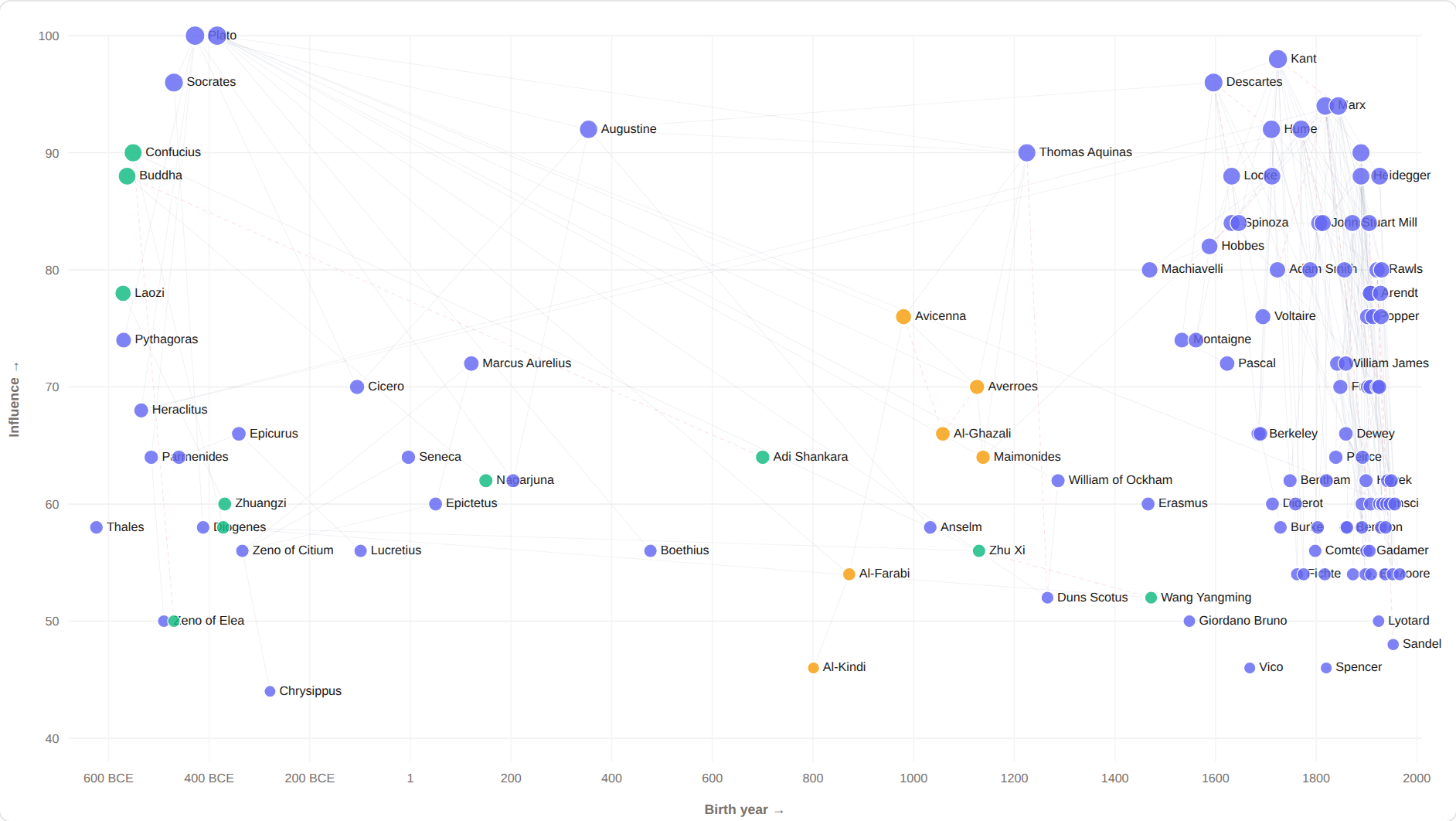
- Philosophical map
The major philosophers placed on two axes — time and influence.
- Seeing Like a State — a reader's summary
James C. Scott's 1998 classic on why grand schemes to improve the human condition fail. Also in History & Politics.
- The Age of Surveillance Capitalism — a reader's summary
Shoshana Zuboff's 2019 book on behavioral data, prediction products, and a new form of power. Also in History & Politics.
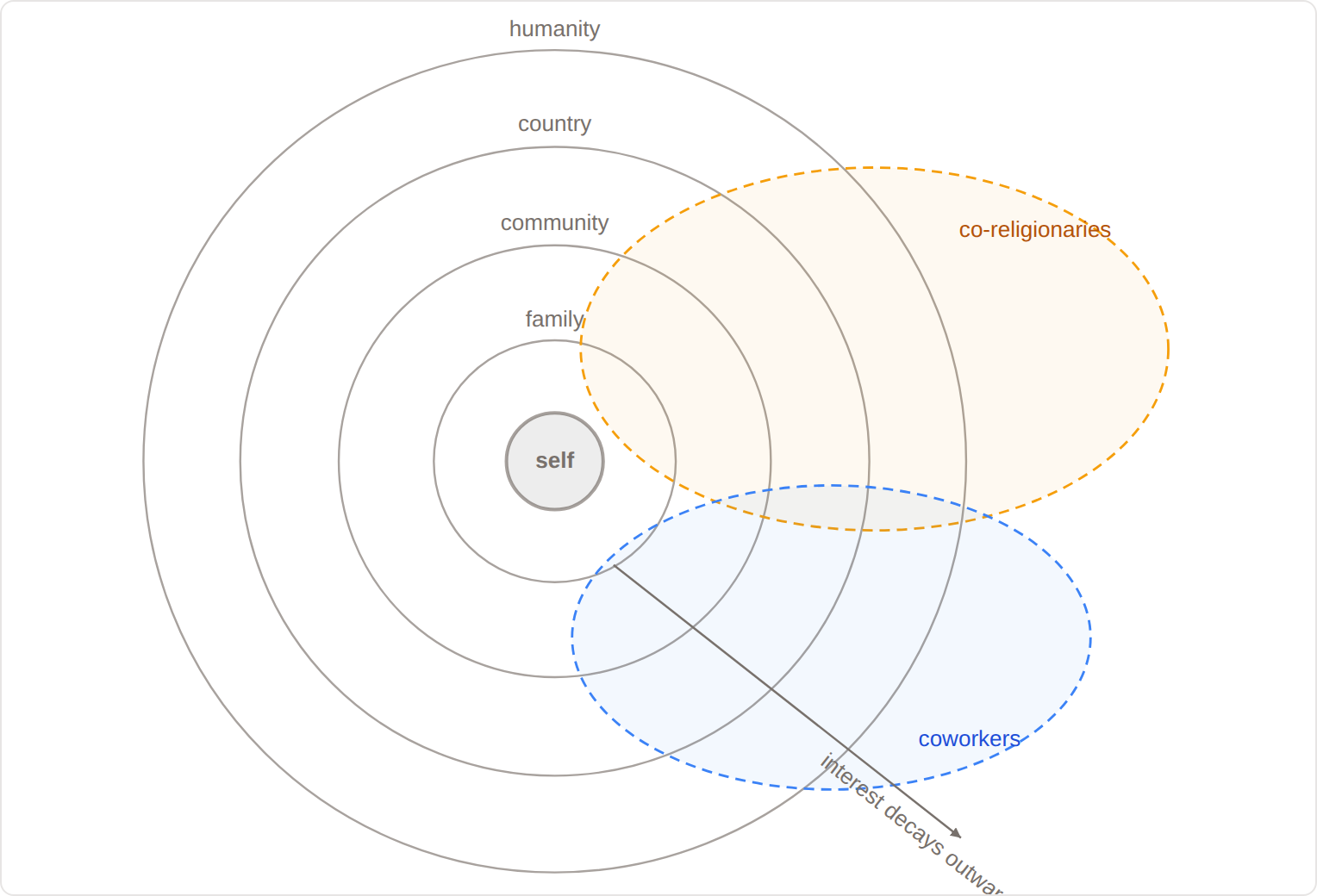
- The circles of interest
Politics as a trade-off of resources across circles around the individual — a methodology, ten probes, a research program. Also in Politics.
- The Construction of Social Reality — a reader's summary
Searle's 1995 classic: its history, author, main ideas, critiques, and afterlife.
- The factory as institutional fact
Searle's social ontology applied to factories — and to the AI agents now writing institutional facts. Also in Business.
- The Gulag Archipelago — a reader's summary
Solzhenitsyn's 1973 masterwork: its clandestine history, author, main ideas, critiques, and impact on the world's political sentiment.

_Skating_on_Duddingston_Loch.jpg?width=800)


%2C_from_Los_Caprichos_-_Google_Art_Project.jpg?width=800)
.jpg?width=800)


_-_The_Moneylender_and_his_Wife_-_WGA14281.jpg?width=800)


.jpg?width=800)
_The_Blind_Leading_the_Blind.jpg?width=800)


%2C_The_Nightmare%2C_1781.jpg?width=800)


%2C_published_1799%2C_NGA_7502.jpg?width=800)


.jpg?width=800)


.jpg?width=800)