History & Politics
Notes and visualizations on power, government and their history.
28 entries
- Curtis Yarvin — the Cathedral, neocameralism, and the tech right
The programmer who blogged as Mencius Moldbug and became the political philosopher of parts of Silicon Valley: the Cathedral, formalism, the state as a company with a sovereign CEO, exit over voice, RAGE — and how the ideas reached Washington. His life, main ideas, critiques, and impact.
- Audience Capture — a reader's summary
The feedback loop that drifts a creator's persona toward whatever their audience rewards — Eric Weinstein's early use of the phrase, the 2022 essay that spread it using a mukbang YouTuber as its case study, and why the label is as contestable as the pundits it's applied to.
- Availability Cascade — a reader's summary
Timur Kuran and Cass Sunstein's 1999 theory of how repetition alone manufactures a claim's apparent credibility — the 1989 Alar apple-scare, “availability entrepreneurs,” and why platforms that display share counts shortened the cycle from weeks to hours.
- Bothsidesism — a reader's summary
Boykoff & Boykoff's 2004 study of “balance” in US climate coverage, Jay Rosen's view from nowhere, a 1974 Miami Herald column that used the word decades early, and why the accusation is as contestable as the practice it names.
- Dog Whistle Politics — a reader's summary
A coded-language accusation borrowed from an 1876 device for testing animal hearing — its mid-1990s Australian polling origin, Ian Haney López's 2014 book, and why a claim about covert meaning can never quite be settled.
- The Straw Man Fallacy — a reader's summary
Refuting a weaker substitute for an opponent's real argument — the phrase's own false Westminster Hall etymology, Douglas Walton's 1996 formalization, and the 2006 blog contest that named its “weak man” cousin nutpicking.
- Dunbar's Number — a reader's summary
Robin Dunbar's 1992 estimate that the brain sustains roughly 150 relationships, Gladwell's Gore-Tex anecdote, and the 2021 reanalysis that challenges the precision of the number.
- The Spiral of Silence — a reader's summary
Elisabeth Noelle-Neumann's 1974 theory that fear of social isolation mutes minority opinions — its West German polling origin, and why anonymity hasn't broken the spiral online.
- Tragedy of the Commons — a reader's summary
Garrett Hardin's 1968 essay on shared resources destroyed by rational self-interest, and Elinor Ostrom's Nobel-winning evidence that real commons usually avoided the tragedy on their own.
- Groupthink — a reader's summary
Irving Janis's 1972 theory of how cohesive groups suppress dissent to preserve consensus, the Bay of Pigs case that inspired it, and the mixed evidence for whether cohesion itself is really the culprit.
- Cunningham's Law — a reader's summary
The internet adage that the fastest way to get a right answer online is to post a wrong one — Ward Cunningham's wiki-era observation, a secondhand quote, and why it's folklore about provocation rather than a tested law.
- Illusory Truth Effect — a reader's summary
The 1977 finding that repetition alone makes a claim feel truer, and why knowing the right answer doesn't fully protect you. Also in Philosophy.
- Horseshoe Theory — a reader's summary
Jean-Pierre Faye's bent-spectrum model of the far left and far right curving toward each other, and the political-science case that it measures authoritarian style, not ideological substance.
- The Gish Gallop — a reader's summary
Named for creationist debater Duane Gish, coined by Eugenie Scott in 1994 — the tactic of firing off more claims than an opponent can rebut in the time allowed, and its kinship with Brandolini's Law.
- Whataboutism — a reader's summary
A Cold War deflection tactic with a 1970s Irish name (“whataboutery”), the 2008 Russia coverage that spread the “-ism” spelling, and why the accusation is nearly as abusable as the tactic it describes.
- Overton Window — a reader's summary
Joseph Overton's mid-1990s range of politically acceptable ideas, the ladder built after his death, and how it became both an activist strategy and an online conspiracy accusation.
- Purity Spiral — a reader's summary
A group's internal contest over ideological commitment that escalates until only the most extreme position counts as pure — far older than the internet, and symmetric across ideology.
- Godwin's Law — a reader's summary
Mike Godwin's 1990 Usenet adage that long enough arguments always produce a Nazi comparison — the deliberate meme experiment behind it, and the blunter corollary he never fully endorsed.
- 10×, then 100×: the case for scaling R&D
If we are serious about becoming a multi-planetary species, we should multiply fundamental and operational R&D by 10 to 100 — especially as AI automates operative jobs.
- Forms of rule through history
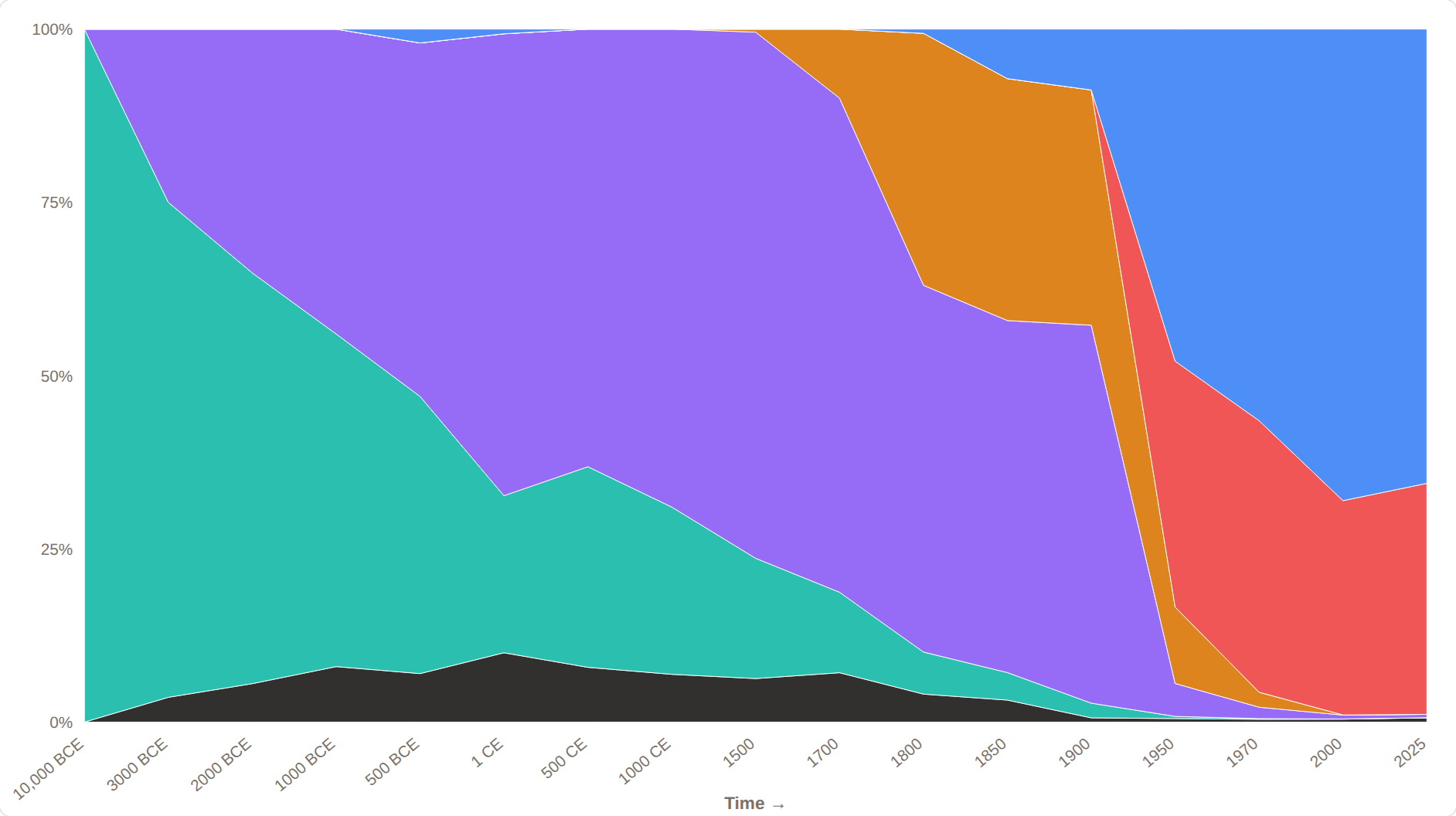
The share of humanity living under each form of rule over time — counting the enslaved.
- French law — map, debates & reform directions
The main branches of French law, what's contested in each, and editorial directions for reform.
- Measuring λ: a first estimate for France
The circles-of-interest coefficient computed once, crudely: smooth private decay, plateau-and-cliff public settlement.
- Occupations of humans
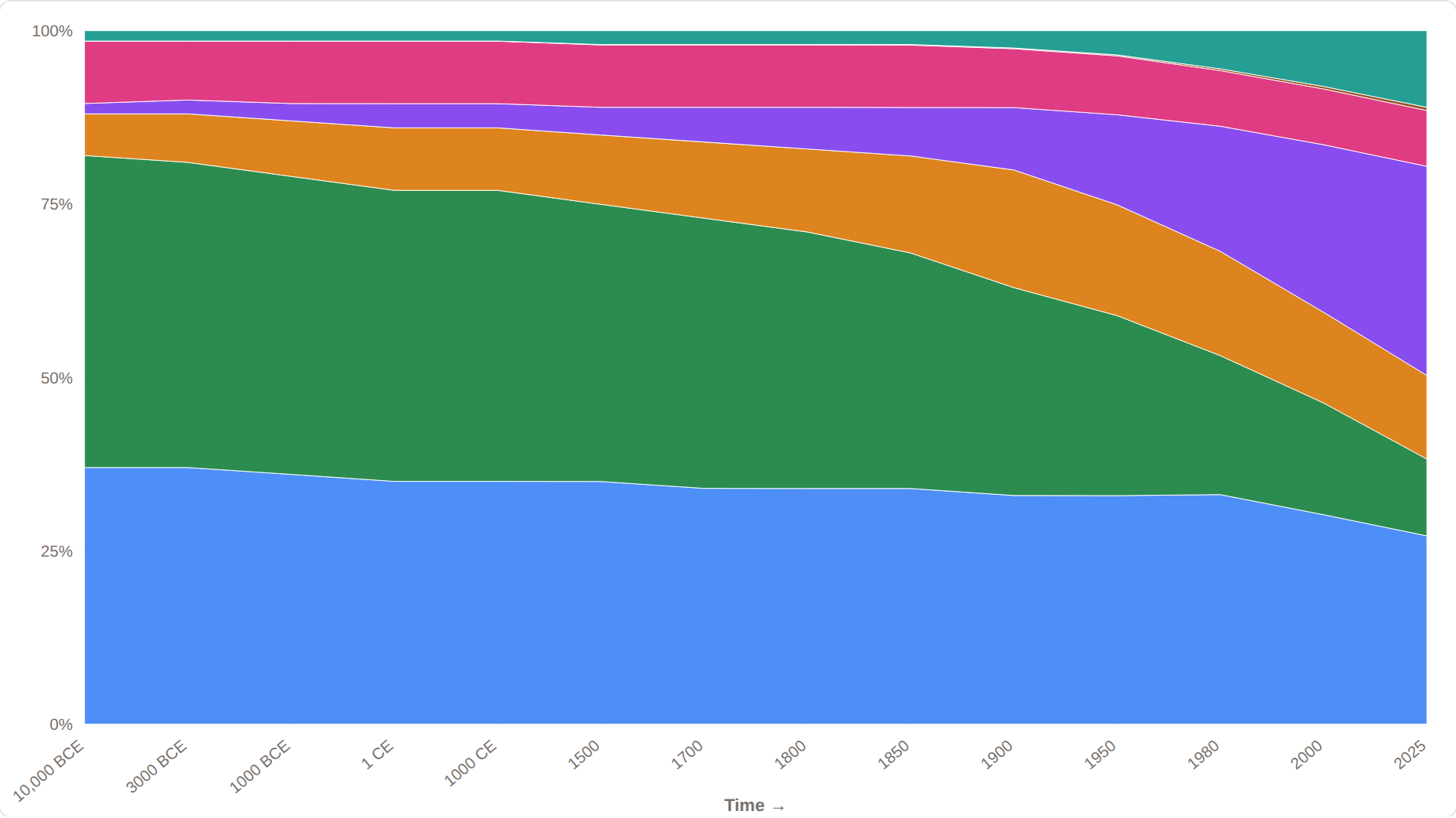
How humanity spends its time — learning, food, physical and non-physical work, care, research, retirement — as a slice of total human time from 10,000 BCE to today.
- Power structures through history
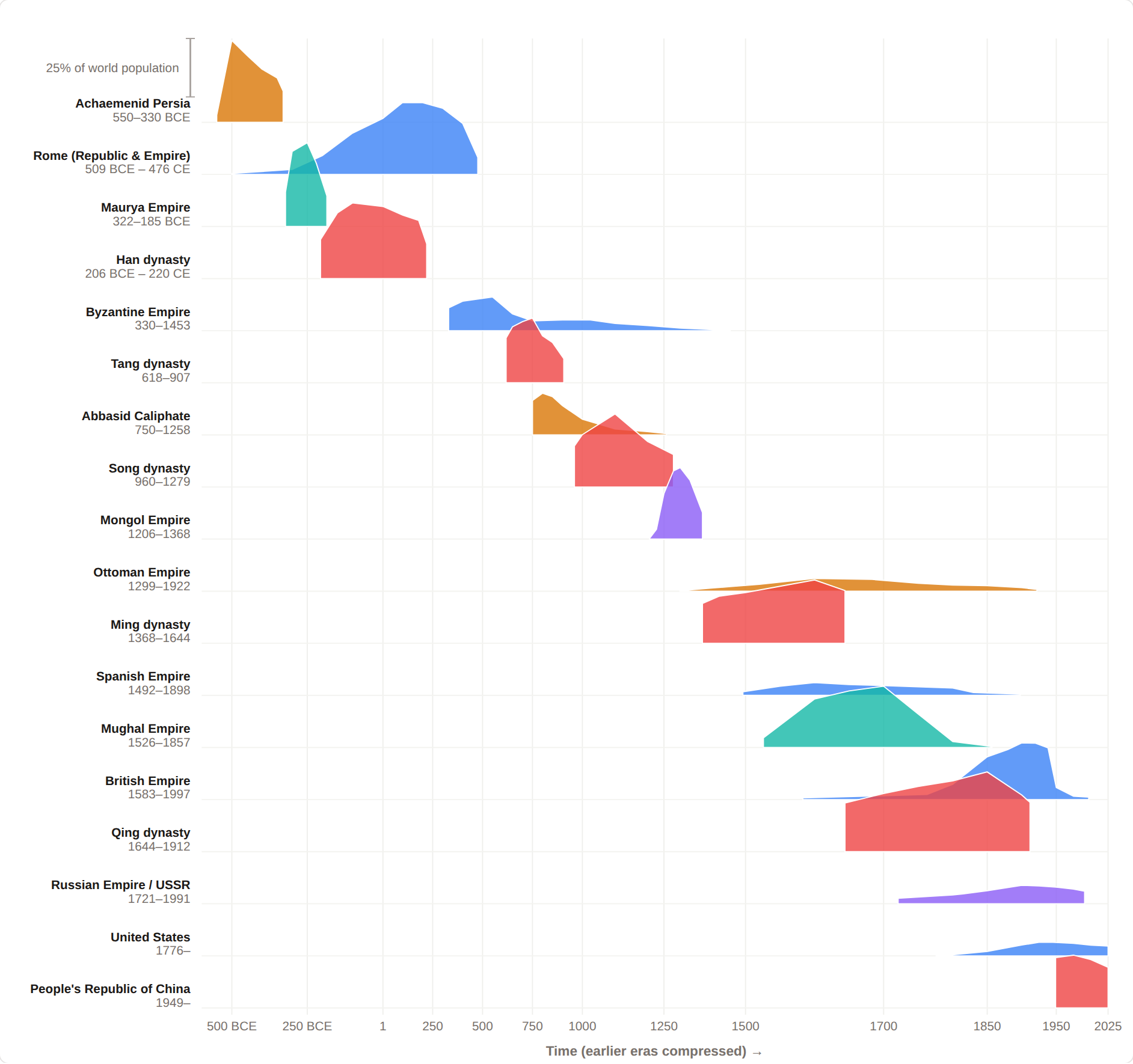
A timeline map of the major power structures — from Achaemenid Persia and Rome to the Byzantine Empire, the Mongols, the British Empire and today's superpowers — and their relative strength in people ruled, GDP and military might.
- Preference Falsification — a reader's summary
Timur Kuran's theory of the gap between public and private opinion — why 1989 looked sudden, and what it explains about online conformity and opinion cascades.
- Seeing Like a State — a reader's summary
Legibility, high modernism and metis: why grand state schemes fail. Also in Philosophy.
- The Age of Surveillance Capitalism — a reader's summary
Behavioral data, prediction products, and instrumentarian power — the book behind the vocabulary of today's data-regulation debates. Also in Philosophy.
- The circles of interest
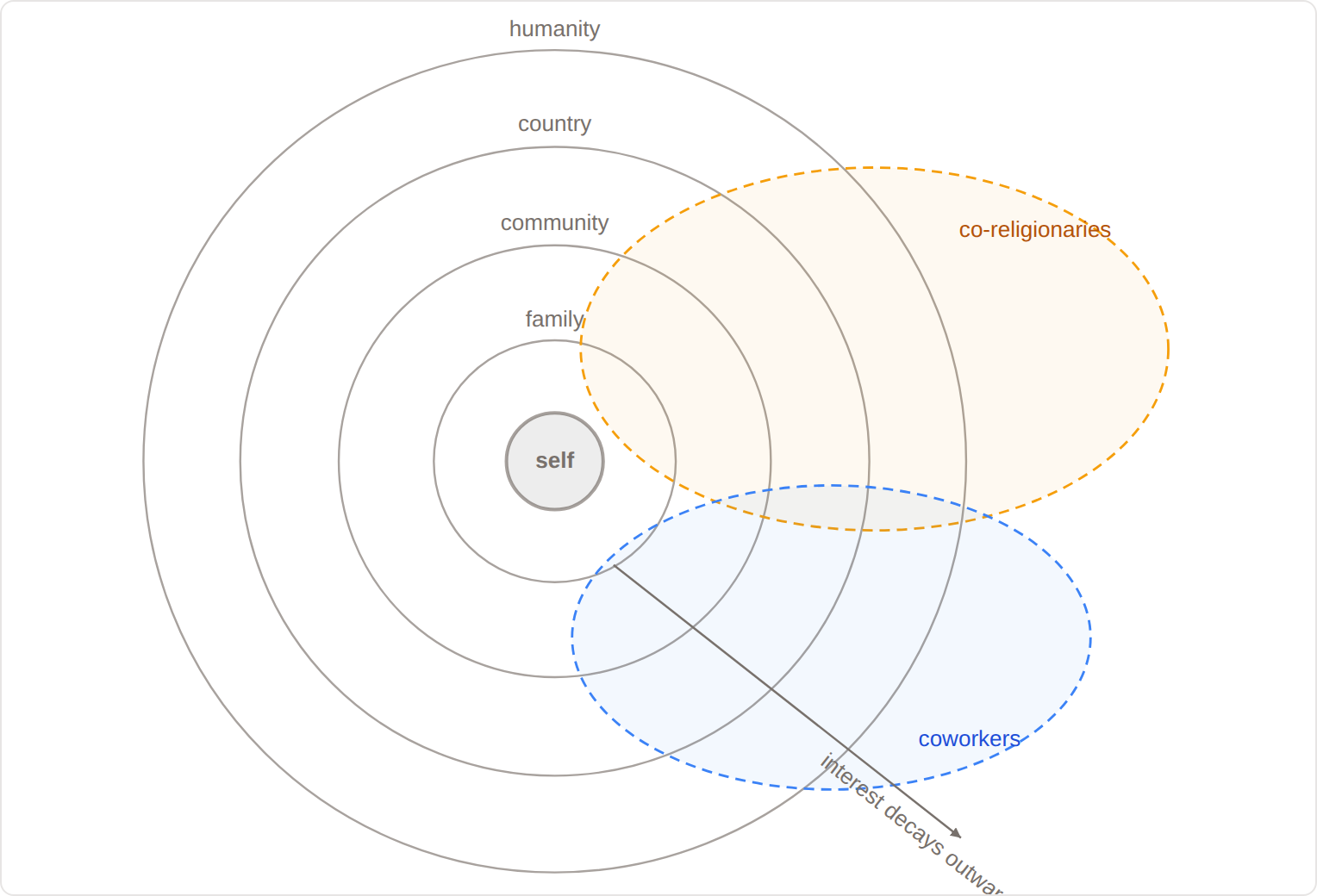
Politics as a trade-off of resources across circles around the individual — a methodology, ten probes, a research program. Also in Philosophy.


.jpg?width=800)


%2C_published_1799%2C_NGA_7502.jpg?width=800)





.jpg?width=800)