
Hi everyone ! I’m Renan, founder of OSS, leading venture builder and investment fund specialized in operations.
Last week , one of our portfolio startups achieved something we believe is a first in its category: the full automation of a complex physical product system — from bill of materials to default-free production — orchestrated end-to-end by AI agents.
It worked first pass.
We also have put now exponentially more systems in production than before.
Since then, one question keeps coming back: how do you actually get there ?
The answer is less glamorous than most expect. The focus tends to drift toward models, prompting strategies, or agent frameworks.
In practice, the decisive factor sits elsewhere.
It is ontology, which is a fancy term describing the data structure of the underlying knowledge graph.
Convergence Is Real
Across multiple startups, industries, and technical teams, a pattern is emerging: architectural convergence.
Independently, teams are landing on similar system designs. The tools vary, the stacks differ, but the underlying structure looks increasingly alike.
Once systems move beyond surface-level use cases and into real automation, ambiguity becomes the limiting factor. Systems either resolve it structurally, or they fail under it..
The Three Layers of an AI-Native System
Effective AI automation systems tend to organize themselves into three layers.
The Descriptive Layer
This is the foundation.
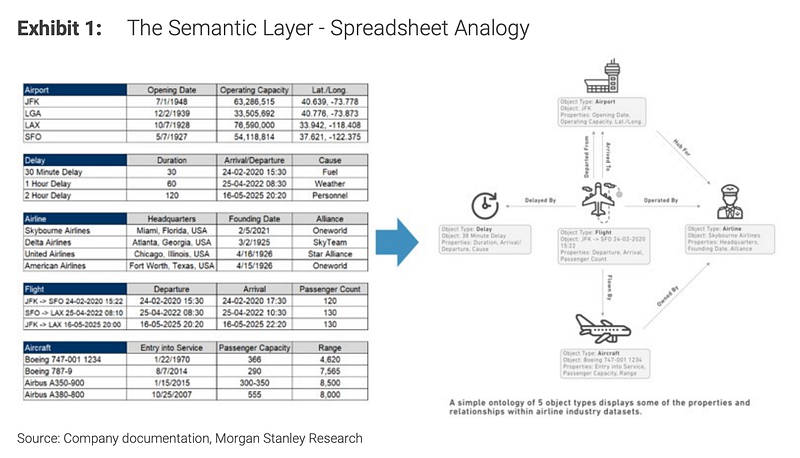
A well-formed ontology typically contains between 50 and 200 core objects for a given domain. Not thousands. Just the right level of abstraction.
In a physical production system, this includes machines, factories, raw materials, components and intermediate parts (often tied to 3D representations), and people with defined roles. Each of those objects has attributes (machine : size, location, price, …) and is linked to multiple other objects (this machines belongs to this factory, …)
This layer defines what exists.
It looks simple on paper and is rarely simple in reality. Most of this knowledge is tribal, undocumented, and context-dependent. It does not sit cleanly in databases. It emerges through conversations, edge cases, and exceptions.
Usually our conversations start with something like “We just deployed our entire MES for millions of dollars and you’re telling me 40% of the objects that are needed to do the job are not in the system ?”.
The Dynamic Layer
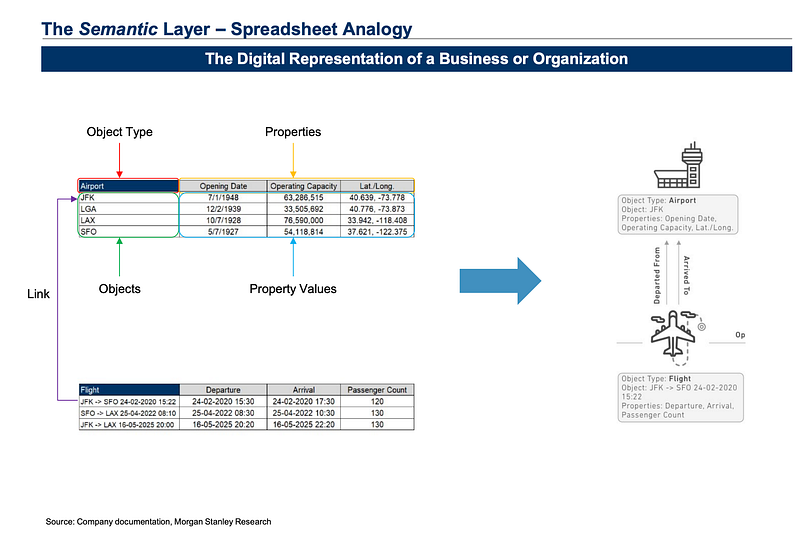
Once the ontology captures what exists, the dynamic layer captures what happens.
Manufacturing orders are created, materials are consumed, tasks are assigned, issues emerge, delays propagate.
Everything here is stateful and interdependent.
A delay in one machine does not stay local. It reshapes priorities, resource allocation, and downstream outputs. A faulty program can cascade into second- and third-order effects across the system.
Systems that treat actions as isolated events tend to break down here.
For example for a machine : a work order started at XX:XX and got an issue 23 minutes later that was handled by a particular person which resulted in a change of program that is now stored elsewhere and an over-consumption of raw material.
The Kinetic Layer
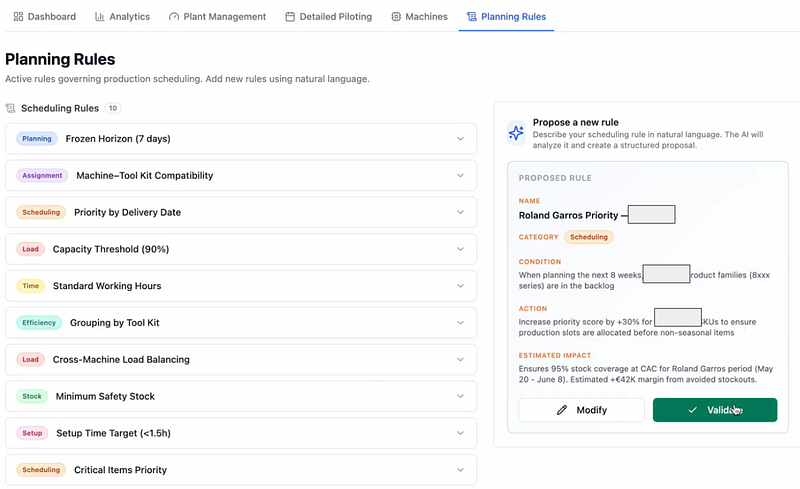
Above the dynamics sits a layer that is almost always implicit, at best hard-coded in systems.
This layer governs intent, possibilities, propagation in the network.
It encodes how decisions are made, which trade-offs are acceptable, how the system behaves under stress, and what outcomes are considered optimal.
It shapes behavior over time rather than describing individual events. Without it, systems optimize locally and degrade globally.
Two core findings about the kinetic layer power our companies :
- Legacy software have hard-coded rules that are part of the kinetic system that are routinely not known by teams, not governed, with second-order effects that can be devastating, and are not adaptative enough to create value (examples : MRP2 calculations, raw material consumption by kilogram rather than by geometry, …) ;
- A very large part of the kinetic layer is possessed by humans armed with excel, improperly documented decisionmaking, and/or 300 pages PDFs that actually power the company (examples : “design rules” of 300 pages PDF with all the company tribal knowledge for new designs, “planning rules” that sit ontop of 40Mb excel files that routinely destroy a part of the MRP2 calculations, override its faulty logic with company-critical brittle workflows. Actual quote : “you override the ERP after the sunday calculation because otherwise it will be all wrong”).
The kinetic layer is where the value aggregates. The simple fact of exposing, governing, disambiguating and applying a quality gate process to those routinely change the performance of companies.
It is also incredibly dangerous, as the kinetic layer is the living brain of the companies. It is crucial for this layer to be exposed, governed and ultimately checked by humans. Black boxing this part is suicide.
Why Ontology Becomes the Bottleneck
A recurring assumption is that AI systems fail because of model limitations.
In practice, failure tends to come from context ambiguity.
Many companies layer AI on top of loosely structured data, often through RAG-style approaches. Early results can look promising, then degrade as ambiguity accumulates. Hallucinations are a symptom, not the root cause.
The system lacks a clear understanding of what entities are, how they relate, and how they differ. Prompting techniques do not compensate for missing structure.
And the kinetic systems that are competing (humans taking decisions, legacy systems doing their work) will destroy the output of said system.
The Reality of Building It
Building a production-grade ontology remains a manual process.
The underlying knowledge is fragmented, inconsistent, and often implicit. The same term can carry different meanings depending on the team, the context, or the moment. There are competing teams for the same piece of kinetic layer and/or context layer.
Extracting it requires direct interaction with operators, engineers, and domain experts for the V0, and then multiple rounds of alignment through real-world example cycling.
AI agents are beginning to take on a meaningful share of the work, especially when documentation exists. Roughly 60% of the initial structuring can be automated in favorable conditions.
The remaining work is where most of the difficulty lies: reconciliation, disambiguation, and validation against real-world behavior.
These steps still depend heavily on human judgment.
Knowledge Graphs, But Grounded
We think production knowledge graphs are likely to become standard infrastructure across companies within the next decade.
One assumption does not hold well in practice: the idea of a single unified graph spanning the entire organization.
What tends to work is more modular:
- domain-specific subgraphs
- explicit connections between them
The reason is both technical and organizational.
Organizational : Ontologies are shaped by roles, workflows, and incentives. Attempts to flatten everything into a single abstraction layer often introduce more ambiguity than clarity.
Technical : The actual data structure is job-dependent. One does not want the same data structure for a machine from the point of view of an R&D practitionner or a production practitionner.
The Hidden Constraint on AI
When the ontology is well-formed, downstream systems become more reliable. Automation stabilizes, agent behavior becomes predictable, and system-wide optimization becomes tractable.
When it is not, progress stalls quickly.
A consistent pattern across projects is that weak ontology design correlates strongly with failed AI initiatives. Early prototypes succeed, then fail to scale as ambiguity compounds.
What Comes Next
Tooling is improving. Agents are becoming more capable of extracting structure from existing documentation. The cost of building these systems is decreasing.
The core challenge remains grounded in how organizations understand and describe their own reality.
Making that explicit, precise, and shared across systems is the work.
Ontology is becoming a central layer of AI systems, whether it is recognized as such or not.
If This Resonates
If you are an industrial player trying to move beyond pilots and into real automation, or a technical founder working on AI-native systems, we would be glad to exchange.
Let’s build.
Credit to the structuration of the ontology goes to the good folks at Morgan Stanley on their very good piece about ontology for the muggles. The rest goes to Cognyx, one of OSS portfolio companies.