
A view from the field
Our past few years at OSShave been spent deploying software in places where abstractions are tested quickly: factories, supply chains, procurement teams, quality departments. Environments where software interacts directly with physical assets, cash, and responsibility. This perspective shapes how the evolution of the software stack looks when stripped of hype and viewed from operations.
This is not a manifesto or a prediction meant to age well on social media. It is a snapshot of how things are converging when AI systems are put into production and forced to coexist with real constraints, an honest take on what we see and where we think things are headed.
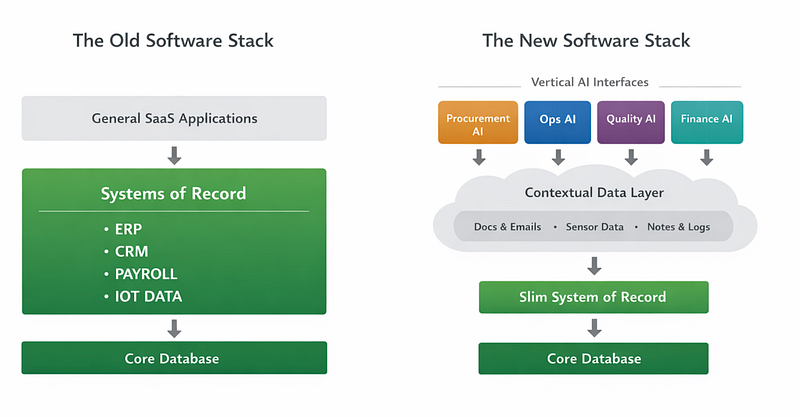
Systems of record will remain, but recede
Certain categories of systems are anchored too deeply in trust, regulation, and determinism to disappear. Payments, accounting, payroll, compliance reporting, and machine-level IoT signals tied to safety all fall into this category. These systems must remain auditable, predictable, and legally defensible. That reality does not change because models improve.
What changes is their footprint. The surface area these systems occupy in daily work is shrinking fast. Fewer screens are touched directly. Fewer humans adapt their behavior to the shape of a database. The system of record becomes quieter, thinner, and more infrastructural. It continues to exist, but mostly out of sight.
Ownership of these systems will remain concentrated. Trust, switching costs, and regulatory gravity favor incumbents. The transformation is not about replacing them, but about how little users need to interact with them.
Data expands around the core, not inside it
While systems of record stay relatively contained, the data environment surrounding them expands aggressively. Organizations already generate massive volumes of information that rarely fit clean schemas: emails, specifications, PDFs, maintenance notes, sensor traces, conversations, and tacit operational knowledge. Historically, the cost of structuring this data made it unusable.
AI changes that balance. Instead of one clean, centralized data model, dense clouds of semi-structured context emerge around core systems. Data is extracted on demand, reconciled probabilistically, enriched continuously, and often never written back in canonical form.
The system of record states what officially happened. The surrounding data captures what appears to be happening. That gap turns out to be useful rather than problematic, as long as it is acknowledged and managed.
Interfaces become vertical and opinionated
The most visible shift is not in infrastructure, but in interfaces. Horizontal software designed to serve everyone equally struggles in an AI-native environment. What scales instead are interfaces tightly aligned with specific roles: buyers, planners, quality engineers, plant managers.
Each interface exposes a partial view of reality, expressed in the language of the job, shaped by its constraints. These systems do not merely display information. They propose actions, highlight tradeoffs, and increasingly carry most of the reasoning load.
Human involvement moves up the abstraction ladder. Early on, validation happens at the transaction level. Over time, it shifts toward validating rules, and later toward validating objectives. The interface becomes the place where intent is expressed, not where data is manually reconciled.
In practice, these systems are never purely AI-driven. They are hybrids. Deterministic code remains where failure is unacceptable. AI-generated logic fills in areas where variability is tolerable. Human curation stabilizes the whole. Much of the code is now produced by machines; most judgment remains human.
Productivity gains are real, and difficult
These architectures can produce order-of-magnitude productivity gains. That potential is visible in narrow slices of organizations already. Achieving it at scale is difficult.
The systems cut across existing systems of record, which brings integration complexity and organizational friction. They operate in probabilistic space, which forces explicit decisions about trust, error handling, human oversight, and a whole lot of ad-hoc coding where needed (generated by AI, so it’s /10th of the cost). They reshape workflows, which inevitably shifts power and accountability.
This is why many AI products remain impressive demonstrations without becoming durable tools. The work that makes them stick is rarely glamorous: dealing with edge cases, reconciling messy data, deploying slowly, and earning trust from users who have good reasons to be skeptical.
A restrained conclusion
For now, AI does not remove software from the stack. It rearranges it.
Systems of record persist, thinner and quieter, with minimal process layer mainly operated by AI agents. Data grows around them, richer and less rigid. Interfaces become vertical, opinionated, and closer to actual work. Humans move up the abstraction stack, away from execution and toward intent, managing a complex set of rules.
This does not simplify software. It increases its leverage while raising the bar for how carefully it must be built.
From the ground, this is the direction things appear to be taking. The details will evolve. The constraints will not.